
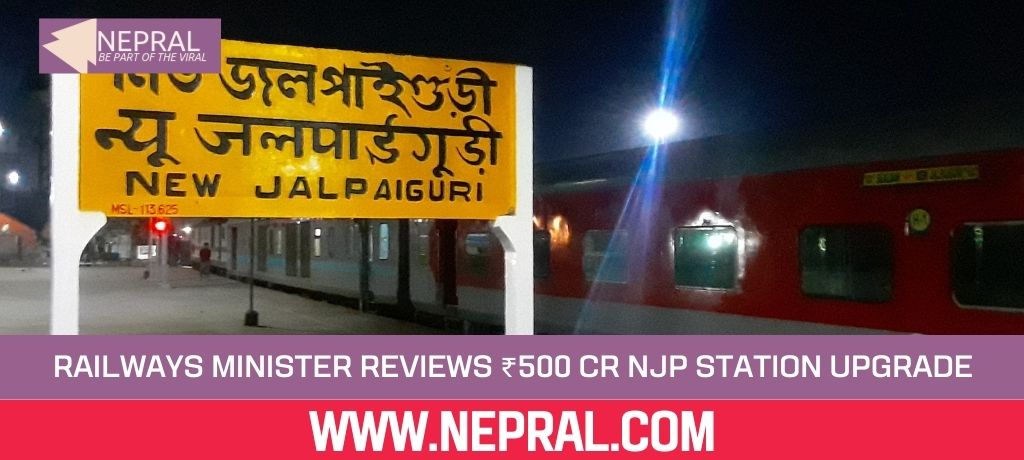

Railways Minister Inspects NJP Redevelopment as Station Set for Major Capacity Expansion
New Jalpaiguri (NJP), one of eastern India’s most strategically located railway stations, is undergoing a major transformation aimed at improving passenger experience and strengthening regional connectivity. Union Minister for Railways Ashwini Vaishnaw on Friday inspected the ongoing redevelopment works at NJP, which is being upgraded under the Amrit Bharat Station Scheme to meet world-class standards.
Officials said the redevelopment of NJP is a centrally funded project with an allocation of ₹500 crore and is expected to significantly enhance the station’s operational capacity and infrastructure. Once completed, the station will be able to handle nearly double its current daily footfall, addressing long-standing congestion issues in North Bengal’s primary rail hub.
A Key Gateway for Eastern and Neighbouring Regions
New Jalpaiguri railway station plays a critical role in India’s rail network, serving as the main entry point to North Bengal and the Northeast, while also acting as an important transit gateway for neighbouring countries such as Nepal, Bhutan, and Bangladesh. With rising passenger numbers driven by tourism, trade, and migration, railway officials have identified NJP as a priority station for comprehensive redevelopment.
During the inspection, the Railway Minister reviewed progress on passenger facilities, station circulation areas, and future-ready infrastructure. Officials accompanying him highlighted that the upgraded station is designed to support smoother movement of passengers, improved accessibility, and modern amenities in line with national standards.
Capacity to Double Under Amrit Bharat Station Scheme
According to railway authorities, NJP currently caters to around 60,000 passengers per day. The redevelopment project aims to increase this capacity to approximately 1.2 lakh passengers daily, a move seen as essential to meet the region’s growing travel demand.
The Amrit Bharat Station Scheme focuses on holistic station development rather than isolated upgrades. At NJP, this includes expanded platforms, modern waiting areas, improved signage, upgraded ticketing systems, better pedestrian flow management, and enhanced safety features. Officials said the design also takes into account future traffic growth, ensuring the station remains functional for decades.
“The objective is to create stations that are not only efficient transport nodes but also comfortable public spaces,” a senior railway official said during the inspection, adding that NJP’s redevelopment reflects the scale and importance of the station in eastern India.
Boost to Rail Connectivity in West Bengal
Speaking to officials during the visit, the Railway Minister noted that railway infrastructure development across West Bengal is progressing at an accelerated pace. He indicated that more than 100 railway stations in the state are currently undergoing renovation as part of various redevelopment programmes.
He also stated that over a dozen new train services in the state are expected to be flagged off by Prime Minister Narendra Modi in the coming period, underlining the Centre’s focus on improving rail connectivity and service coverage. These additions are expected to benefit both long-distance travellers and daily commuters across the region.
Officials further indicated that NJP is likely to see an increase in originating and terminating trains once redevelopment is complete. With improved infrastructure and operational efficiency, the station could emerge as a major hub for future services, including those linked to proposed economic and technology-driven developments in the region.
Strategic Importance for North Bengal’s Growth
The redevelopment of NJP is being viewed not just as a transport upgrade but as a catalyst for broader regional development. North Bengal relies heavily on rail connectivity for tourism, tea industry logistics, defence movement, and cross-border trade. Improved station infrastructure is expected to reduce delays, improve travel reliability, and enhance the overall image of the region for visitors and investors.
Railway planners also see NJP as a potential anchor station for future intercity and semi-high-speed rail services. With better integration between rail, road, and nearby air connectivity at Bagdogra, the upgraded station is expected to strengthen multimodal transport in the region.
Minister’s Visit Linked to Upcoming Train Inaugurations
After inspecting the NJP works, the Railway Minister boarded a train to Malda to attend scheduled inauguration programmes related to new rail services, including advanced long-distance trains. Officials said these initiatives are part of a broader national effort to modernise India’s rail network through improved rolling stock, upgraded stations, and enhanced passenger services.
The Minister’s visit to North Bengal underscores the strategic importance of the region in the Railways’ expansion plans, particularly as passenger volumes continue to rise post-pandemic and with increased economic activity in eastern India.
Conclusion
As redevelopment work continues at New Jalpaiguri, railway officials remain confident that the upgraded station will set a new benchmark for passenger convenience and operational efficiency in eastern India. With its capacity set to double and its facilities aligned with modern standards, NJP is poised to play an even more significant role in connecting North Bengal with the rest of the country and neighbouring regions. The coming months are expected to bring visible progress, reinforcing the station’s position as a critical gateway in India’s evolving railway infrastructure.